
Trending
This story is from December 19, 2021
Women who fought the Portuguese and social stigma
Most recognised freedom fighters may be male, but the story of the other half is no less stirring, wrote Manohar Rai Sardesai
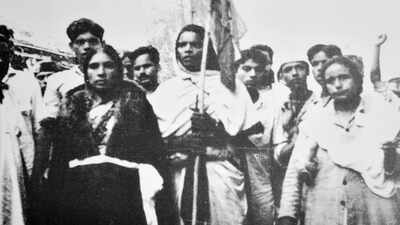
On August 15, 1955, a women’s squad led by Sahodaradevi Rai held a Satyagraha march
“For young women to even stand up to those Portuguese officers and those ‘pakle’! Do you know how daring that was? Even 10 women were like a hundred of them. Look at those times, women couldn’t even step out,” says 89-year-old Naguesh Karmali.
And he would know, he was in the thick of things. Karmali was sentenced to 10 years in jail on September 15, 1954, serving five at Aguada and Reis Magos before being freed.
Surrounded by towering books at his Ribandar home, he talks of times when forest-dwellers between Quepem and Rivona sheltered a rag-tag group of freedom fighters who were criss-crossing villages, rallying for liberation.
The growing involvement of women in politics is linked to Goa’s liberation struggle. The Portuguese rule helped improve the status of women in society by abolishing Sati and polygamy. They could remarry and there was emphasis on education. Emboldened with their place in society, it wasn’t long before women turned the tables on the colonists.
Accounts suggest that Dr Ram Manohar Lohia’s meeting on June 18, 1946, demanding civil liberties spurred women to take up the liberation struggle. They turned up in large numbers at Margao and were then seen regularly at meetings, protests, satyagrahas, roused at times by the patriotic fervour brought on by fierce discussions expressed inside homes.
Any talk about Goa’s Liberation movement and you will find that the role played by women is rarely glorified. The fact is that there is a whole pantheon of women who faced unimaginable physical and mental torture in their quest for a free homeland.
Most of the freedom fighters were young women across caste and classes. They hated the Portuguese regime and were inspired to free Goa.
Consider young Vatsala Pandurang Kirtani who stood up to the Portuguese police commandant at the meet at Margao on June 18, 1946. He questioned her for raising the slogan ‘Jai Hind’ in defiance of his direct orders. The fearless lass turns around and says, “Just as the words ‘Viva Salazar’ fill you with pride, so does ‘Jai Hind’ galvanise my spirit.” She was promptly arrested.
A testimony to the bravery of Goan women freedom fighters can be found in the codices of the infamous Tribunal Milatar Territorial — the military court established by the Portuguese in Panaji to prosecute those involved in the freedom struggle.
The military court manuscripts maintained by the archives department make for a most insightful reading, especially stirring accounts of women freedom fighters and the persecution they faced from the Portuguese. A woman freedom fighter went deaf in one ear from the beating she received, according to military accounts.
Among the more prominent is Sudha Madhav Joshi, popularly known as Sudhatai, from Mardol, Ponda. Sudhatai was arrested at the Mapusa garden square for carrying the Indian flag. She was sentenced to 10 years imprisonment and slapped with a penalty of 20 escudos per day, with an additional suspension of all her political rights for 20 years, including internment for two years on grounds of security measures. The allegation-- attempting to entice the local population to commit crimes against the Portuguese government.
Prema Purab from Pissurlem, Sattari, helped to carry arms from Belgaum, through the forests, to Mohan Ranade in Goa. On one such mission she was fired at by the Portuguese police and a bullet hit her in the leg. The injured Purab escaped to a mining area belonging to Dayanand Bandodkar, from where she managed to get into a mining truck and made it across Goa’s border to Belgaum to receive treatment.
The Braganca sisters also feature in the annals of Goa’s struggle — Dr Beatriz and Berta de Menezes Braganca, daughters of late Luis de Menezes Braganca.
Berta was a leading figure in the struggle and had defied the ban on civil liberties by speaking publicly. She strode alongside her uncle T B Cunha at protest marches and speeches in South Goa.
Berta also founded a fortnightly in 1958 in Bombay called ‘Free Goa’ and she toured India demanding military action against the colonists. She was also chief of the Goa wing of the Indian National Congress. At a meeting planned on June 30, 1946, in Margao, she and Cunha were prevented from speaking. She boldly took on the police and both were shoved into a car and abandoned by the roadside at Chandor.
Prabhakar Sinari, who was deeply involved with the militant struggle to free Goa, says, "The women contributed a lot to Goa's freedom movement. Despite women being suppressed in our society in those days, they came forward. Their participation was not negligible. Some of them were even manhandled by the Portuguese policemen, but this did not deter these women.”
The Portuguese certainly did not hold back. Women were tortured, regularly imprisoned, subjected to humiliation, interrogation, intimidation and even to third-degree methods.
In the face of all political adversity and bullying by colonial forces they are known to have stood their ground.
Shashikala Hodarkar was arrested and sentenced by the military court for possessing ‘subversive literature’ while proceeding from Poinguinnim to Margao. She operated from across Goa’s border under the guidance of Peter Alvares, secretary of the National Congress Goa. This meant she would have had to frequently trek through forests to access border areas.
Inspired by Sindhu Deshpande, Hodarkar offered satyagraha on February 17, 1955, at Margao and was arrested for distributing pamphlets. She was shown physical torture that male political prisoners underwent (beating and laying on ice) to dissuade her campaigns, which only strengthened her resolve.
The quest for freedom meant women were also forced to live underground like their male counterparts. Sometimes they ended up being imprisoned at the same time as their husbands, which meant their children had to be looked after by extended families.
Vatsala Kirtani, who was arrested on June 18, 1946, after she stood up to deliver a speech at the same meeting organised by Lohia, also finds mention in the manuscript. After she was arrested, a group of 40 women marched to the station demanding her release. The face-off came to a boil and the police relented since all the women wanted to be arrested along with Vatsala. Even though she was officially released, she refused to leave and had to be physically hauled out of prison by the same commandant.
Libia Lobo Sardesai invokes immediate connection with Goa’s Liberation struggle for running the underground radio station, ‘Voice of Freedom’. Libia is known to have made repeated announcements of the ultimatum to the last governor-general to surrender to the Indian Army.
Other names that feature in the struggle for Goa’s Liberation include women within and outside the state who actively participated to liberate Goa---Maria Joaquina Calista Araujo, Kishoribai Harmalkar, Srimati Divkar, Laxmibai Paingunkar and Suryakanti Faldesai from Canacona, Dr Laura D’Souza, Kumudini Paingunkar and Sindhu Deshpande from Poona, Shalini Lolienkar, Shanta Hede, Shashikala Almeida, Mitra Bir, Rajani Naik and Lalita Kantak.
Sharada Padmakar Savaikar was 16 when she was arrested by the feared police officer Casmiro Monteiro on suspicion of murdering a local from her village of Savoi-Verem. He was a known Salazar sympathiser. Her father and three brothers were imprisoned and continuously tortured. Savaikar spent two years in jail before being produced before the military court, where she called out Monteiro’s cruelty by showing the judge the scars she sustained from the beatings.
She lost her teeth in the beating but refused to buckle under Monteiro’s threats of “you’ll rot in prison for 14 years”, and instead told him she was ready for it. She maintained her innocence and did not betray any of her members.
In a strange twist, release orders for a Sharada Shirvaikar came through, and the Portuguese police confused the names and released her instead.
Celina Olga Moniz from Saligao was arrested on January 26, 1955, for carrying the Tricolour. At the Panaji jail she was severely tortured and released only in October.
She is known to have helped the underground nationalist movement in Goa and neighbouring states to provide support and financial assistance. Most of her associates, who were involved with the original planning of Goa’s freedom struggle at a meeting held at the residence of Dr Jose Francisco Martins in June 1954, were arrested and tried at the military court. Moniz is the recipient of Tamrapatra from the central government, one of the highest honours for political prisoners.
Stay updated with the latest news on Times of India. Don't miss daily games like Crossword, Sudoku, and Mini Crossword.
End of Article
FOLLOW US ON SOCIAL MEDIA







Photostories

Hot Picks
TOP TRENDING
Popular Categories
Hot on the Web
Top Trends
Trending Topics
Mamta KulkerniPushpa 2 ReviewVikrant MasseyAmitabh BachchanWeight GainBaba Vanga PredictionsAmitabh Bachchan HomePushpa 2 Movie ReviewPushpa 2 LeakedOptical illusionSamantha HouseBaba Vanga Predictions 2025Hair RegrowSkincare Tips for WinterWeight Loss TipsHair FallBill GatesSpotify Wrapped 2024Elon Musk
Living and entertainment
Latest News
When Samantha Ruth Prabhu cried at a public event post her divorce from Naga Chaitanya: 'That's how much I love...'Where Is Jade Cargill? WWE Insider Breaks Silence After Survivor Series WarGames No-ShowPakistan ex-PM Imran Khan indicted for inciting violence against militaryStrong earthquake strikes Northern California, tsunami alert issuedCeedee Lamb’s injury could put a sudden end to the Dallas Cowboys' playoff hopes this seasonUHC CEO killer may have used a modern version of rare WWII spy gun: Report‘Muhammad’ is the most popular boys' name in England and Wales‘How soon can you remarry after a spouse dies?’: Google search history leads to murder charges against a man in VirginiaDenver Nuggets vs Cleveland Cavaliers (12/5): Prediction, prop bets and best picks, starting five, injury report, key players, streaming details, and moreVanessa Bryant delighted by Taylor Swift’s gift honoring late Lakers icon Kobe BryantGoa to tap public to help test PWD drinking water with field testing kitsNYT Connections game hints and answers for December 6, 2024'Unjust, funds inadequate': India's strong stance on climate change case in ICJGoa to implement NEP for special schools from 2025-26Ayesha Curry and Mychal Wiggins, partners of Steph Curry and Andrew Wiggins, celebrate Draymond Green’s 1-year-old with heartfelt birthday messagesRashmika Mandanna wears Vijay Deverakonda's sweatshirt while watching 'Pushpa 2' with his family in HyderabadZaheer Iqbal admits Sonakshi Sinha was 'very scary' in Sanjay Leela Bhansali's 'Heeramandi': 'I don’t like her when she’s sad'5 reasons your hair is falling in this season; 5 remedies to control it
Copyright © 2024 Bennett, Coleman & Co. Ltd. All rights reserved. For reprint rights: Times Syndication Service